Popular Posts

Showing posts with label mental illness. Show all posts

Friday, December 17, 2010

It's a Small World Afterall


The idea for the title came while browsing through mental health news articles. One,from India caught my eye. DR. ENNAPADAM S. KRISHNAMOORTHY,writes:"Once again, in October, I had the privilege of attending Chennai's international festival of short films on mental health, “Frame of Mind” organised by SCARF (the Schizophrenia Research Foundation India). My task was to interact with the audience after the Richard Gere film, “Mr. Jones” about an extraordinarily charming man with bipolar affective disorder (manic depressive illness)."
The review of the film is superb. I've seen the film, in fact I own the film. I bought it years ago simply because of the high profile actors, and the fact WalMart was selling it for a dollar. Often they have tubs of films marked down and you have to patiently go through them to find a bargain. It is not one of his better films and I, not having read about the movie, did not know at first he was portraying a bipolar victim.

I did not at the time think too much of it, and had it not been for the review I would not say it was an especially good movie. But on a second evaluation, I can see how it would show the actions of a manic episode. A little hyped up probably and it is well to understand that not all manic depressive patients act this way.

In the review, the members of the group discuss the film and comment. Someone mentioned there was a difference in American ways of looking at Bipolar than perhaps in theirs, but truthfully, I would have thought it was written by an American psychiatrist or psychologist, had I not been told the review originated in India.

Issues they brought up, are issues here. In order to get movie goers to buy a ticket, there must be a love relationship. There is one in this movie, and that is a no no there as well as here. But the heroine takes herself off the case afterwards, since she understands she overstepped the bounds of medical ethics. Again I say, read the review, then watch the movie if you want to get a glimpse of manic-depression in action.

I agree with the reviewers the movie should be 'taken with a grain of salt'. Movies and real life are not the same. And certainly where bipolar and other mental illnesses are concerned, there are certain characteristics common to each illness that can be looked for, but for bipolar, the hyped up episodes mainly follow the individual traits of the person.

As an example, take a so called normal person in his or her ups and downs and fast forward these. The actions would all be different because the personality, ambitions, and makeup of the individual are different. It is the acceleration of the mood that makes it out of place. As in the case of the movie "Mr. Jones", one would get the notion by watching the movie, he thought he could fly like a bird. Normal people like to fly, and they do, but they do so by simulation, in planes designed for the purpose of flying.

By contrast a bipolar victim could just as easily go beyond the limits of the norm, and with acceleration of their desire to set the world straight would start preaching to crowds about the fact if God had wanted man to fly he would have given him wings. Of course that is true, but the earth is not heaven, and mere mortals are not angels.

Back to the the Hindu magazine and the article about Mind Matters and "A True Balance." It is one of the best descriptions about the heartbreak of bipolar I have read, at least recently. I will be checking in with them regularly to see what other pertinent ideas they generate concerning health issues. As a note: When researching a topic and the news source is Hindu, check it out. This is the daily paper of India, and is a well respected paper. The magazine with the review just mentioned, is aligned with this paper.

PS: The scroungy looking art work is, like the victims of mental illness, somewhat torn and out of sorts. It is nothing more than a collage I designed once as a book cover. The book was written, the cover was designed, but neither went the file cabinet. To me it is a window on the world as seen through a window pane. And of course I will not apologize for it being frayed and tattered, aren't we of the world, especially those who suffer from mental illnesses not of our own making, also frayed and tattered? We want nothing more than to see light at the end of the tunnel.

Saturday, November 13, 2010

Mental Health, or Mental Illness: Where do we draw the Line?


Mental Illness or mental Health, where do we draw the line, or do we? The answer for me lies somewhere behind those dark glasses of the self-portrait I drew of myself in the early nineties. Truths are hidden there known only by me. It goes something like this: It would not be mentally healthy if I decided to admit that I drew the portrait with help from technology.

It is easily recognized as being yours truly and I was able to render it so because an error in printing out a copy of a photograph resulted in a slight outline of where my features should go. Otherwise, my art ability would not have allowed me to get my nose right, my mouth in right proportions to my facial features, and it would not have been me. As it were, I looked at the real photograph and tried to copy as near as possible what I saw. At the time I liked the results and framed it, hung it on the wall and thought little of it.

What of the dark glasses though? They were items I could draw and eyes I could not. Therefore to cover up my lack of drawing skills, I covered my eyes with dark glasses. It was an easy way out of a confusing situation. What does this confession have to do with the title of this article? Everything? It says that my discomfort in perpetuating lies is healthy, that my desire to be a better artist is likewise healthy, that my self interest in using myself as subject matter is somewhat in between.

In comparison, had I kept silent about the actual rendering of the self-portrait -- even though no one probably cares -- I would be furthering my narcissism by passing off, ever so slightly, something not totally mine. To whom do I give that part of the credit? To my Creator, that is who is responsible for my features being where they are on my face, and for giving me a look that is uniquely my own. A person less given to introspection and less devoted to reality, would have passed on that one, but I chose not to do that.

In a less mentally healthy time of my life, I decided once and for all to be truthful in the small things in my life as well in the large things. That was a healthy thing to do and most likely it made a large impact on the tug of war going on between my mental health and my mental illness.That problem was settled and was out of the way. Furthering my path toward mental health was knowing what to keep untold when it was no one's business but my own. I had to weigh the risk of hurting others against my own desire to be truthful.

Therefore, my quest to be all that I can be, does not give me the right to cast shadows of doubt on others. That statement means simply that I will not be be doing any tell all stories on my journey to shed light on mental illness and to show it up for what it is. The only stories I will tell will be on myself, and when others are involved, they will in no way be blamed for anything that happened to me. My parents had their good and their bad, and I hold no grudges. That is indeed healthy, and I believe that wherever they are, that is comforting to them. Love, I believe, when the final analysis is in, must weigh in on that.

Self portraits that we paint mentally of ourselves, or in reality, should be as honest as they can be. To allow them to perpetuate lies and distortions that could distort honesty and fair dealings are wrong, and should not be allowed to detract from our mentally healthy tally sheet. Even though we cover our eyes with dark inpenetrable glasses, we can still see through our own charades. Do we want that? Not if we prefer to stay safely, if only in longing, on the mental healthy side versus the mentally ill side.

Friday, November 5, 2010

Today's headline: Health reform and mental illness


Fox Business news today alerts mental illness sufferers that there is something in the recent health reform laws that concern them. Expansive coverage for illnesses not formerly covered, or covered adequately, is now available through PPACA (Patient Protection and Affordable Care Act.)This legislation took effect September 23, 2010.

Barbara Mannino, writing for Fox Business, explains how PPACA helps the mentally ill. "Mental health advocates continue to herald the Patient Protection and Affordable Care Act (PPACA) as an enormous win for people with mental disorders.

PPACA mandates coverage parity, putting mental health treatment on par with medical care, which means deductibles, copayments, and doctor visits can’t be more restrictive for mental illnesses than medical and surgical coverage.

This means that people who suffer from substance use disorder and illnesses like bipolar disorder, major depressive disorder or schizophrenia, are provided the same coverage as those with cancer, diabetes or heart disease.

Also, if a plan provides for out-of-network medical benefits, it must provide the same for mental health benefits, as well.

PPACA also means that the immediate reform changes that went into effect Sept. 23 under the health-care reform, apply to mental health conditions: non-denial of coverage for children with pre-existing conditions under age 19; preventing lifetime limits on coverage, not allowing new plans to set annual coverage limits; and requiring new plans to offer family coverage for dependents up to age 26.

According to the National Institute of Mental Health, (NIMH) approximately 58 million Americans suffer from a mental disorder in a given year, with about 1 in 17 (6%) suffering from a serious mental illness.

About 20% of U.S. youth during their lifetime are affected by some type of mental disorder that impairs their daily activity, according to a new NIMH national study based on 10,000 face-to-face surveys of 13 to 18 year-olds.

Another 22.2 million Americans aged 12 or older need treatment for substance abuse or dependence, according to the Department of Health and Human Services’ 2008 statistics, the latest year data is available.

Evolution to Parity

“The stigma of mental-health based disorders was at one time enormous, has lessened recently, says Peter Newbould, director of Congressional and political affairs at the American Psychological Association.

“Today there’s a greater understanding that the mind and body are connected. The American people got that before members of Congress did.”

Health-care reform moves beyond the Wellstone-Domenici bill, which was passed in 2008 and became fully effective in July. That legislation was praised as a breakthrough for parity, but only covered Americans in group health plans.

PPACA expands parity to include people with individual health insurance policies, small businesses, and by 2019, will ultimately cover about 32 million uninsured Americans.

Coverage will come through a combination of state-based private insurance exchanges and a Medicaid expansion of the poverty level, according to the National Alliance on Mental Illness (NAMI).

A little more than half of those 32 million will probably go into state exchanges, where they can purchase coverage with pooled risk and therefore lower premiums, says Andrew Sperling, NAMI’s director of legislative advocacy."

PS: The image is actually the only part of today's message that is mine.The yarn project was done several years ago and, although at the time I have no idea what I had in mind at the time I constructed it, I believe it's unknowns fit in well with the workings of the mind. If only we knew more about what brings on mental illness, wouldn't that be great? In the meantime thanks to those who never give on human values and God-given opportunities to make life better for someone somewhere.
Effie Moore Salem

Thursday, November 4, 2010

Today's Headline: Revised definitions of mental illness


While checking out the headlines on Google this morning, I ran across an excellent and thought provoking article from the Stanford Encyclopedia of Philosophy.It was first published in November 30, 2001 but has a "substantive revision this past Feb. 22, 2010. I printed out all twenty-one pages of it to have it on hand as a general guide toward further research.

The second paragraph caught my attention: "The central philosophical debate over mental illness is not about its existence, but rather over how to define it, and whether it can be given a scientific or objective definition, or whether normative and subjective elements are essential to our concept of mental illness. . . "

Naturally, when dealing with philosophical subject matter, most of what is written is rhetoric saying nothing. But while sounding profound and educated, at least this academic article does get around to saying that mental illness is as baffling as it has always been. Once it thought mental illness was caused by demons, but then a later enlightened public thought that statement cruel and untrue. Now honesty about health in general dictates that mental illness is as illusive as ever, and just as tormenting to those with it and those trying to make sense of it.

What do I think? I definitely think evil worsens mental illness by focusing attention not on its cure but on how to get even with those who cause the mentally disturbed distress. It is certainly not a secret that good and evil live side by side in a sort of tug of war. When one is mentally ill and all his faculties are not in good working order, then the sufferers are not responsive to whatever help comes their way. And too, they may not be capable of discovering their own abnormal vs. normal behavior simply because their mental capacities are not in good working order.

In other words, some things are not worth fighting over, but tell that to those with mood disorders. They may agree with you, but often it is after an explosive incident, and not before it happens. The treatment option is to get to these individuals before they go haywire and do what they will come to regret when they finally do come to their senses. How to do that is the sixty-five dollar question facing medical scientists today.

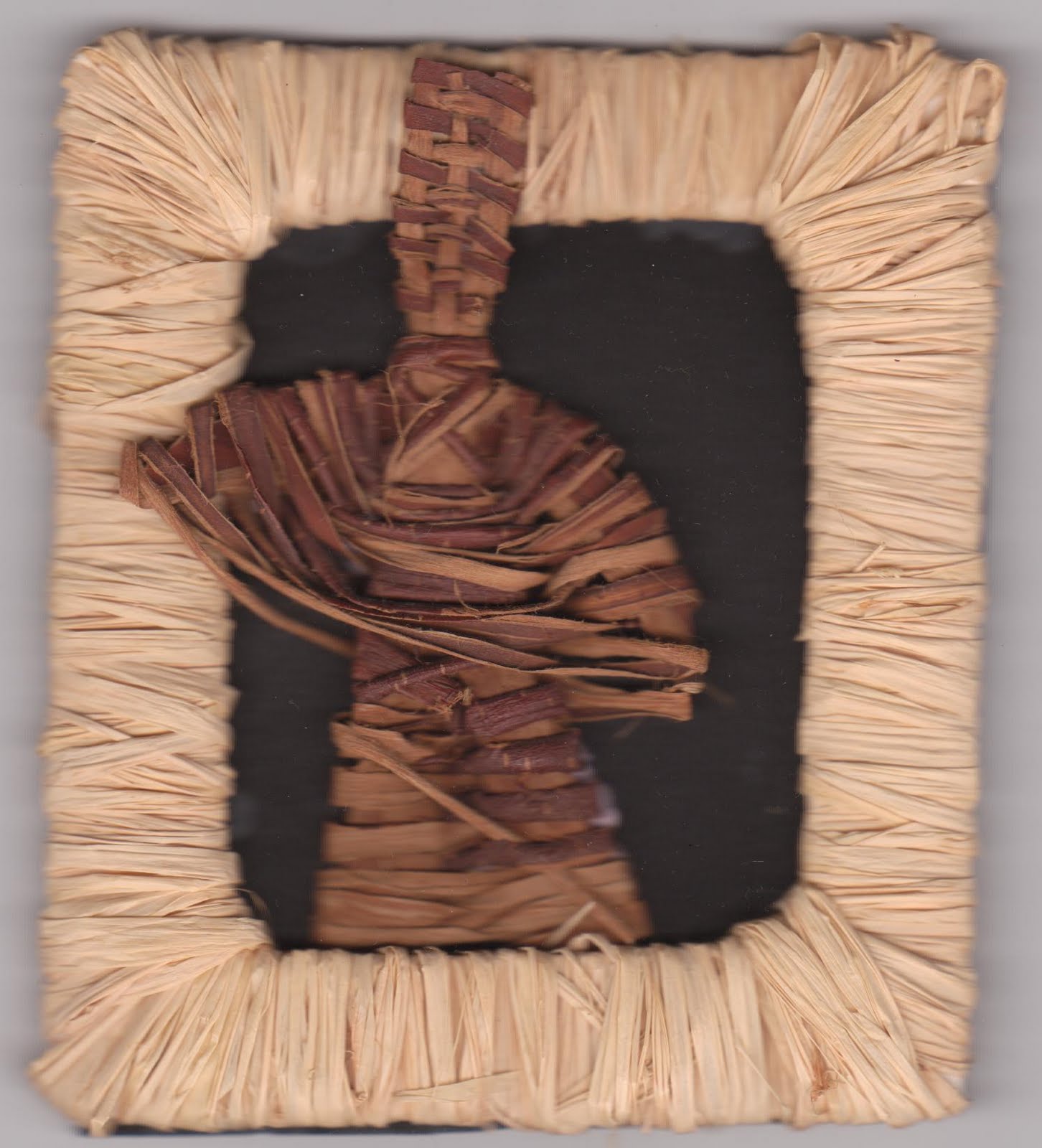
PS: The image is a favorite. It was an a fun thing I happened to do one afternoon when I was sitting on my front porch in Eastern Kentucky. A bit of elm bark shaped this bit of nostalgia and it has remained my favorite. The frame was made from purchased raffia. It actually is not much larger than it is shown here.